
Serving Eastern Pennsylvania, Central and Southern New Jersey, and Delaware
Serving Eastern Pennsylvania, Central and Southern New Jersey, and Delaware

Do you dread entering your laundry area because it’s filled with piles of dirty clothes and who knows what else? Now is a good time to make a clean, fresh start!
1. Visualize your ideal space.
· Picture how you would like the room to look and consider how it should better function.
2. Reduce the excess.
· Remove items that don’t belong in the laundry room and put them where they really should live.
· Eliminate items you don’t want (use up, share with others, donate, or toss).
3. Maximize the space.
· Install shelves or cabinets above and/or next to washer and dryer.
· If space allows, place a narrow rolling cart between your washer and dryer to store small items.
· Install a wall-hanging ironing board, hanging rack and/or folding table to save space.
4. Organize what you keep.
· Assign a home for each item, keeping similar items together.
· Keep frequently-used items close at hand and less-frequently used items higher or lower.
· Dedicate space for sorting dirty clothes; use bins or rolling carts to separate and contain whites, colors, delicates, and heavily soiled items.
6. Decorate the room.
· Hang artwork, put down a throw rug, purchase attractive hampers, etc. so you feel happy and peaceful in the room.
7. Develop a laundry schedule.
· Make doing laundry a ROUTINE – daily, every other day, weekly, etc.
· Make it as enjoyable as possible – fold laundry while watching TV, talking on phone, etc.
8. Get help from family members.
· Have family members empty pockets, pre-spot and put their dirty clothes in the hamper.
· Delegate the folding of clean laundry and putting clothes away.
9. Follow through!
· Complete the laundry cycle and put clothes away and have family members do the same.
· Reward yourselves with a treat when you’ve completed the process.
BONUS TIP #1: To have a truly clean start, take your accumulated laundry to your local laundromat and have them do the wash for you. Approximate cost = $1.00/lb.
BONUS TIP #2: Use Color Catchers (by Shout) or Color Grabber (by Carbona) when washing lights and darks together. They really do catch the color!
This time of the year many of us are gearing up to head to our favorite beach house or lake cabin. While it may be hectic getting ready to go, once there, you find yourself in a relaxed, organized environment where all you have to do is enjoy each other.
Isn’t it interesting how we can live in a smaller space with less stuff while on vacation but we can’t seem to do it at home? Ok, so maybe it’s because it’s for a short period of time. Nevertheless, take a look at your hotel room, or rented house on your next vacation. Notice how they were able to find usable space within a small area. When you get home to implement some of their space saving ideas, don’t limit yourself by the design of your space.
It always helps to first sort through your belongings and purge what you don’t need (easier said than done, I know). Maybe it’s time to be tougher with yourself…”Do I really need multiple hand towels: fancy, guest, and every day?” Once you have made those culling decisions, it will become easier to see the empty space for its potential.
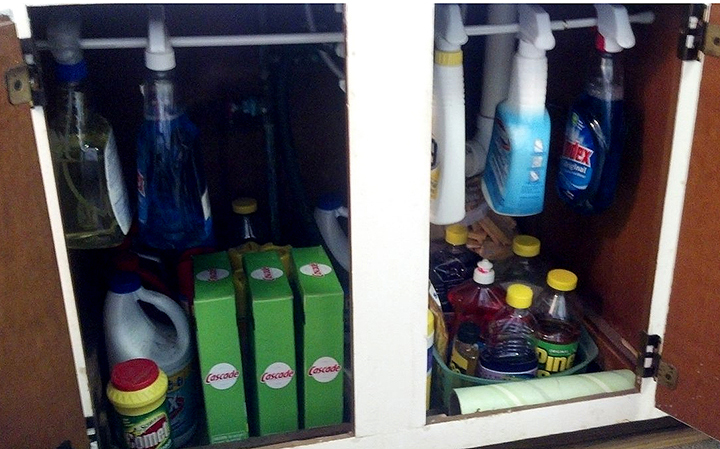
Look up: In most kitchen cabinets, the top half of the shelf is empty space. You can add a small wire shelf to create a second shelf. Also, tension rods make great use of vertical space under your kitchen sink to hang cleaning products.
Look behind doors: For small bathrooms with pedestal sinks, making use of a medicine cabinet can be key. Strategically-placed acrylic stick-on pods can provide additional storage. And don’t forget about repurposing a shoe organizer for behind the door. You can store everything from toiletries…to toys…to crafts!
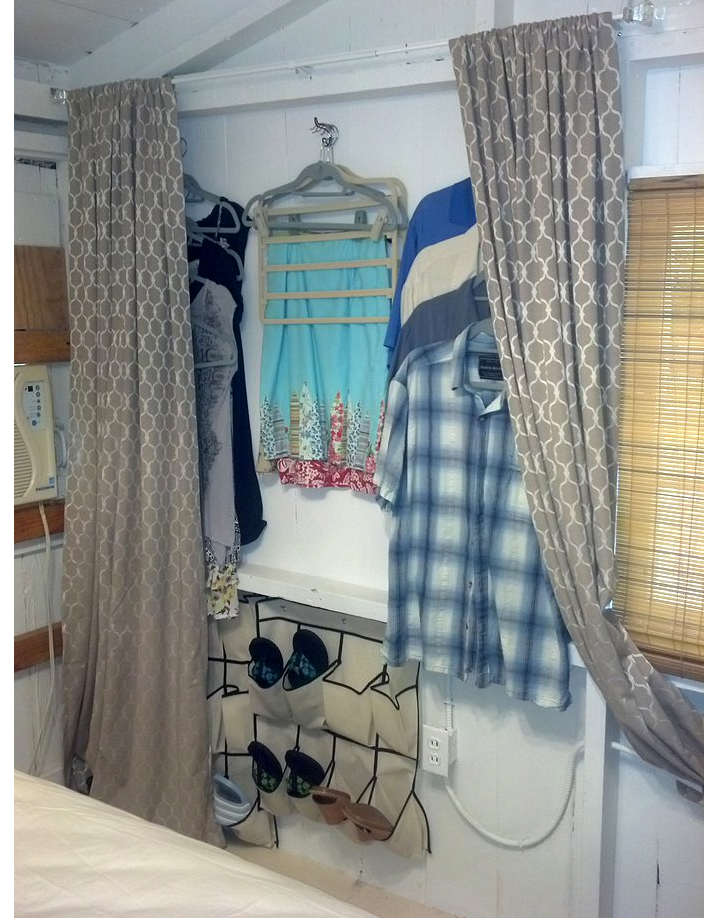
Be creative: Just because it doesn’t look like a place to store stuff, doesn’t mean you can’t create one. For those exposed walls with studs, use hooks and hang drapery to create a closet.
So, take some tips from your next vacation. We love how rested and relaxed we feel after time away from home. There is no reason we can’t create that same type of sanctuary for ourselves year-round.
 Most people want to do the right thing and recycle, but sometimes it’s not easy. Outdated electronics, cans of oil-based paint, and piles of unwanted confidential documents take up valuable space in the basement or garage because you don’t know what to do with them. These things need to be discarded — but how?
There is confusion about recycling. Which things are considered household recycling and which are hazardous waste? You may be surprised to learn that nail polish is hazardous waste. Cellphones are hazardous waste, too. To add to the confusion, companies that pick up your household trash differ in what they accept: some take plastic containers marked 1 through 3 and others take 1 through 7. It’s no wonder people may be reluctant to recycle.
To help make it easier to get rid of your unwanted stuff, follow this list for electronics and hazardous waste recycling and shredding events through the fall in the Greater Philadelphia area. Events are either free or low-cost.
Note: Household batteries can be tossed with regular trash. However, for those with terminals on the same side (such as 6V, 9V or 12V) and button-cell batteries (used in watches, greeting cards and hearing aids), it is important to cover both ends with masking tape to reduce the risk of short-circuiting and fire. For the more common batteries (AA, AAA, C and D), cover the positive terminal (“+”) with masking tape.
Electronics Recycling
Following are permanent drop-off locations for four southeastern PA counties
(At the time of this post, no information for Bucks County was found).
Chester County
Chester County Solid Waste Authority accepts computers and peripherals at the Lanchester Landfill, 7224 28th Division Hwy — Contact Narvon at 610-273-3771
South East Chester County Refuse Authority
219 Street Road, West Grove 19390 — Contact Dawn Robinson at 610-869-2452 (ext. 11)
West Chester Borough
205 Lacey Street, West Chester 19382 — Contact Meghan Fogarty at 610-696-5282
Delaware County
Marple Township offers free electronic recycling to residents at:
Marple Township
446 Marpit Rd. Bromall 19008 — Contact Joe Romano at 610-356-4040
Springfield Township offers free electronic recycling to residents at:
Springfield Delco Public Works
1258 Church Rd., Springfield 19064 — Contact Jeff Bickel at 610-543-2837
Police Court Yard 24/7 or Public Works Facility 7 am – 3:30 pm
Montgomery County
Cheltenham Township – Residents can recycle electronics at:
Cheltenham Township Public Works Facility
8101 Old York Rd., Elkins Park 19027 — Contact William Ferrari at 215-635-4600
Mon. to Fri. 8 am – 3:30 pm, Sat. 10 am – 2 pm
East Greenville Recycling Center
620 West Side Alley, Pennsburg 18073 — 215-679-5194
Mon. to Fri. 7:30 am – 3:30 pm, Sat. 8 am – 12 pm
Lower Merion Township residents can recycle electronics at:
Robert J. Koegel Public Works Complex
1300 N. Woodbine Ave., Penn Valley 19072
Contact Joseph Przybyszewski at 610-667-1952
Mon. to Fri. 8 am – 3 pm, Sat. 9 am – 2:30 pm
Philadelphia County
Computers, monitors, TVs, cellphones and other e-waste are accepted at all HHW locations for residents only. Sanitation Convenience Centers are open Monday through Saturday, 8 am – 6 pm except City holidays. Click here for more info. See locations below.
West Philadelphia
5100 Grays Ave., 215-685-2600
Strawberry Mansion
2601 W. Glenwood Ave., 215-685-3981
Southwest Philadelphia
3033 S. 63rd St., near Passyunk Avenue, 215-685-4290
Northwest Philadelphia
300 block Domino Lane, near Umbria Street, 215-685-2502
Northeast Philadelphia
State Rd. & Ashburner Street, 215-685-8072
In addition –
Best Buy accepts most electronics and large appliances from residential customers at no charge.
Staples offers free technology recycling.
Household Hazardous Waste (HHW)
HHW events are from 9:00 am – 3:00 pm
Saturday, July 11
Spring-Ford 9th Grade Center (Montgomery County), 400 South Lewis Road, Royersford
Thursday, July 16
Streets Department Training Center (City of Philadelphia), 8401 State Rd. at Ashburner St., Philadelphia
Saturday, July 25
Central Bucks South High School (Bucks County), 1100 Folly Rd. Warrington
(enter off Pickertown Rd.)
Saturday, August 8
Abington Middle School (Montgomery County), 2056 Susquehanna Road, Abington
Saturday, August 15
Quakertown High School (Bucks County), 600 Park Ave., Quakertown
Saturday, August 22
Bucks County Technical High School (Bucks County), 610 Wistar Rd., Fairless Hills, (Bristol Township)
Saturday, September 12
Oxford School District Administration Bldg. (Chester County),125 Bell Tower Lane, Oxford
Saturday, September 19
Streets Department 3rd District Highway Yard (City of Philadelphia), 22nd St. & York St., Philadelphia
Sunday, September 20
Penn State University-Brandywine Campus (Delaware County), 25 Yearsley Mill Rd (Route #352), Media
Saturday, October 10
Streets Dept. Facility (City of Philadelphia), 3033 South 63rd St. (NW of Passyunk Ave.), Philadelphia
Government Services Center (Chester County), 601 Westtown Rd., West Chester
Saturday, October 17
Emergency Services Training Center (Delaware County), 1700 Calcon Hook Rd., Sharon Hill (Darby Twp.)
Sunday, October 18
Lower Merion Twp Public Works (Montgomery County), 1300 N. Woodbine Ave.(Lower Merion Twp.), Penn Valley
Saturday, November 7
Streets Department Northeast Facility (City of Philadelphia), 3901 Delaware Ave. (between Castor & Lewis, near Allegheny exit of I-95), Philadelphia
Shredding Events: There is no need to remove paper clips or staples.
Saturday, July 18, 2015, 10:00 – 12:00
Bryn Mawr Trust, Swarthmore Office, 330 Dartmouth Avenue, Swarthmore 19081
(610-328-9998)
Bryn Mawr Trust, Bala Cynwyd Office, 135 E. City Avenue, Bala Cynwyd 19004
(610-664-6293)
Saturday, August 15, 9:00 – 12:00
Montgomery County Commissioners, Abington Junior High School, 2056 Susquehanna Road, Abington (Montco residents only)
http://www.shredone.com/shredding-services/community-shredding-events
Saturday, September 19
Inspire Federal Credit Union, Oxford Valley Mall, 2300 E. Lincoln Hwy Langhorne http://www.titanshredding.com/Community-Shredding-Services.aspx
11:00 – 1:00
Philadelphia Federal Credit Union, 12800 Townsend Road, Philadelphia
Saturday, September 26, 9:00 – 11:00
First National Bank & Trust of Newtown, Bucks County Community College
272 Swamp Rd., Newtown
http://www.titanshredding.com/Community-Shredding-Services.aspx
Saturday, October 3, 9:00 – 11:00
Middletown Township, 3 Municipal Way, Langhorne 19047 http://www.titanshredding.com/Community-Shredding-Services.aspx
Sunday, October 4, 9:00 – 12:00
Montgomery County Commissioners, Lower Merion Transfer Station, 1300 North Woodbine Avenue, Penn Valley (Montgomery County residents only)
http://www.shredone.com/shredding-services/community-shredding-events
Saturday, October 17, 9:00 – 11:30
Merck, Sharp & Dohme Federal Credit Union, Harleysville Branch, 665 Main Street, Harleysville
http://www.titanshredding.com/Community-Shredding-Services.aspx
9:00 – 12:00
Abington Township Public Works, 2201 Florey Lane Abington (residents only)
Monthly Community Shredding Events by Titan Shredding
First Friday of Every Month — 8:30 – 9:30
Bailiwick Office Park, 252 West Swamp Road (Rt 313 & Rt 611 Bypass), Doylestown
Second Tuesday of Every Month — 8:30 – 9:30
Upper Moreland Twp. Library, 117 Park Avenue (off Rt. 611 in Police Dept. parking lot), Willow Grove
Third Thursday of Every Month — 12:00 – 1:00
Shady Brook Farm, 931 Stony Hill Road, Yardley
NOTICE FROM TITAN: Titan Mobile Shredding events may be cancelled due to inclement weather. Call 267-362-4249 with questions, $10 for each copy paper box or equivalent (cash or check), one box minimum, no maximum box quantity, no reservation required.
More events probably will be added in the fall so check your sources for local information. Some politicians host shredding events, so you can also contact your elected officials.
You are encouraged to recycle and shred whenever possible. If you need other options, search online to locate events. Find out the regulations and disposal methods in your area by contacting your trash hauler or local government office.
Every effort is made to ensure accuracy of the information provided. Please verify dates, times, residency requirements, fees, quantity limits and what’s acceptable before going. There may be more events than these so you may want to check other sources.
We thank you for your participation. It feels good to do good!
 As a follow-up to my blog post from last year at this time, I am thrilled to report that the Philadelphia Hoarding Task Force (PHTF) is in its second year and making headway.
In 2013, the Philadelphia Hoarding Task Force a coalition of organizations dedicated to increasing access to services for people with hoarding behavior, created a bold mission:
“To improve outcomes for people who hoard and reduce the catastrophic consequences related to hoarding for residents of the City of Philadelphia.”
An ambitious undertaking to say the least!
In its first year, PHTF had four major accomplishments:
1. Resource Guide – This guide offers immediate and non-immediate resources that may help a person with hoarding behaviors live a safer, healthier life. It can also be used by organizations that have clients who have hoarding behaviors. Please click the link for further details Resource Guide.
2. Helplines – Assist those with questions regarding hoarding-related issues in the Philadelphia area.
Under 60 years of age: 215-751-1800
60 years of age and above: 215-545-5728
3. Website and Social Media Presence –
www.philadelphiahoarding.org
Like PHTF on Facebook
Follow PHTF on Twitter
4. Educational Workshops – “Introduction to Hoarding Workshop”
This workshop is presented by one of PHTF’s Education Committee members and is offered free of charge to the public. These workshops are listed on the website.
Arrangements can be made to have an “Introduction to Hoarding Workshop” done for a specific group or organization that serves the Philadelphia community. Email PHTF at .
Standing on the accomplishments of 2014, the Philadelphia Hoarding Task Force is working to expand its services to include case management, support groups, therapy and cleaning services. The 2015 goals for PHTF are to:
A statistic listed on the PHTF website notes that individuals with hoarding behaviors account for two to five percent of the population—an estimated 23,600 to 59,000 adults in Philadelphia. These numbers are alarming and reveal the need to address this issue individually and as a community.
The approach of the PHTF is based on three key principles:
1. To focus on the person, not the problem or the items they hoard. At the heart of their work is an awareness that behind every hoarded home is a person who needs help, not judgment. They require patience and respect from everyone involved.
2. Since there can be serious consequences for people who hoard because hoarding can be a serious hazard, PHTF advocates solutions that will help resolve emergency issues while also providing support over time.
3. PHTF seeks a balance between the rights of the individual to live as they choose with the needs of the community. PHTF believes that hoarding goes from being an individual struggle to a community problem when it threatens health, safety and livability for those living in a hoarded home, their neighbors, and also the service providers, contractors, and emergency responders entering a hoarded home.
In short, PHTF works to provide individuals and organizations in the region with the tools they need to successfully overcome the challenges associated with hoarding behavior and the public safety hazards that may result.
May the ‘Force’ be with the Philadelphia Hoarding Task Force again this year as it continues to make headway through these uncharted waters!
 “I’m cleaning out my parents’ home and coming across lots of items with sentimental value, how do I decide what to keep?” A friend asked me this question recently. Like so many of us will do in our middle years, she’s facing the dual challenge of grieving while dispersing all of her parents’ possessions. If she’s also the executor of her parents’ estate, she’ll have bills, paperwork, and the responsibility of staging and selling the home as well. It’s a lot to handle at a fragile time. The key to getting through this is to do it in waves, as you have the time and energy.
Below are some suggestions on how to handle the process.
Remove items associated with your parents’ illness. Unless the death was sudden, there’s likely some assortment of medications and medical equipment. Getting these out of the way first will help you release the more recent painful memories and make space for joyful memories to surface. Check Earth911 for places that will accept these items. Some charities and thrift stores, such as Care & Share Thrift Shoppes in Souderton, PA accept medical equipment.
Locate and have the executor disperse any property according to your parents’ wills. If you can’t find some of the items, make a list and leave it in a prominent location. You’ll likely come across the remaining items as you continue to work through the house.
Give away or donate everyday items that don’t hold any particular sentimental value. Usually a fair amount of clothing, kitchen items, books, knick-knacks, small furniture, linens, and items in deep storage (attic/garage/basement) fall into this category. Continue to keep any individual items that you’re unsure about.
At this point, most of what will be left has a chance of being important to you or your family. If you have the luxury of time, invite your relatives to your parents’ home for a ‘claiming memories day‘. Disperse any remaining items mentioned in the will, and open everything else to be given away as keepsakes. The executor may want to set some parameters for this, such as taking turns. Many families find that storytelling naturally emerges from this process. You’ll probably have a lot of tears and laughter. Don’t rush; it’s a precious part of the healing process.
Can you give yourself a little more time at this point? If so, take a break. You’ve fulfilled the requirements of the will, disposed of unnecessary items, and preserved the most important memories. More often than not, some rest and a return to your normal schedule will restore your resilience, stamina, and creativity.
When you’re ready to return to your parents’ home, it probably won’t feel so emotionally charged or overwhelming. You’ll have the confidence of knowing that you won’t accidentally destroy a precious artifact, stumble across an unpleasant memory, or be overwhelmed with unimportant things. In short, you’ll be dealing with the middle ground of your parents’ possessions.
As you work your way through these remaining items, ask yourself a few questions:
-Do I need this to stage the house?
-If I take it home, would I definitely use it?
-Do I know anyone who could use this?
-What charities did my parents support? Do they accept donations?
You’ll likely end up donating or giving away most of these final items. Keep reminding yourself that you already saved the most important things. As the house empties, you may be sad. That’s healthy. Do the work that is easier for you and harder for your family, and ask them to do the same for you. Be gentle with yourself and each other.
Most importantly, cherish your memories as they are the most important thing you’ll keep.
 Believe it or not, it only takes a few steps to get your online files organized. Below are seven steps to help you save countless hours and avoid those embarrassing situations that come from searching for lost files. Let’s get started!
1. Start at the Root
Determine where you want your file system to live on your computer. Having all your files and documents under one ‘root’ folder on your computer will make it easy to locate your files. Many single Windows users have all their folders, files, and documents stored haphazardly in the ‘Documents’ or ‘My Documents’ folder on their PC. If this sounds like your system, then you might want to consider starting from scratch. The easiest way to do this is to save all your current folders, files, and documents to a new folder and name it something like Archive_2015 or any appropriate name that’s easy to remember. Now you can start to create a new file structure with broad categories without losing any of your current information. After your new filing system is created, you can move previously created files and documents to the newly created system on an as needed basis.
2. Create a File Structure
File structure is the backbone of your filing system and it begins with using folders for general categories. Think big when creating filing categories and limit the number of folders to a critical few. Describe the contents of the folders with short commonly used, meaningful terms. Start broad and get more specific as you add files and documents to those broad category folders.
Examples for business folder names:
Administration
Clients
Financial
Insurance
Legal
Marketing
Organizations
Sales
Vendors
Projects
Examples for personal folder names:
Financial
Medical
Health & Wellness
Housing
Insurance
Taxes
3. Use Sub-Categories
After you have created your folders using broad categories, you will want to create files with sub-categories. Sub-categories are used to organized those files and documents within your folders. You may have a folder called ‘Projects’ and within that folder are several files or sub-categories called Project-A, Project-B and Project–C.
4. Determine a Naming Convention
It’s important to name your folders and files consistently and logically. Storing multiple drafts of the same document can get confusing, and a naming convention is one way to avoid that confusion. Also, adding a date at the end of the file name is a great way to keep track of multiple documents, and the addition of initials at the end of the file name will add clarity if more than one person is working on the same document.
Naming convention examples:
Jane_Doe
Jane_Doe_1/1/15
Jane_Doe_1/1/15_JD
5. ‘Save As’ You Go
File your documents in the proper location by using the ‘Save As’ feature. ‘Save As’ allows you to save and file your documents as you go, so they will be placed in the correct file or folder from the start.
6. Clean Up Your Desk Top
Evaluate what you really use and delete those icons or shortcuts that are outdated or infrequently used. Note: deleting a shortcut is not the same as deleting a file, folder or program from your computer. Deleting the shortcut will simply remove it from your desktop. A program like Fences is a great way to automatically sort out all those remaining icons into organized, easy to see boxes and categories. The program can sort the categories for you or you can create your own categories.
7. Backup Your Files
Have a regiment in place to regularly back up your files. If your hard drive fails or is damaged and your only source of backup is your computer, then you risk losing all of your business transactions and correspondence. The rule of thumb for data protection is “if you need it to run your business, then back it up.” Having all your files saved to a ‘root’ will make that process easy.


